

 Back
Back
Water measurement stations to preserve ecosystems near hydroelectric plants
2025.09.08
There are nearly 100 small hydroelectric plants operating in Lithuania, with some rivers, like the Virvytė, having over ten. When establishing hydroelectric plants, it is mandatory to follow the pond usage and maintenance rules stipulated in the Water Law of the Republic of Lithuania, but controlling private owners is not that simple. To ensure minimal negative impact of hydroelectric plants on river ecosystems, water measurement stations are being established. Gediminas Sližys, head of the Hydrological Observations Division of the Lithuanian Hydrometeorological Service, explains more about this.
“The competition has already taken place, and the winners, who are now installing the water measurement stations, have been announced. The purpose of these stations is to record the water level and temperature above and below the hydroelectric plants, while the third parameter—the amount of water flowing through the plant—will be measured by visiting hydrology specialists. In the first phase, under the project ‘Integrated Water Management in Lithuania (LIFE SIP Water),’ twelve stations are planned to be installed by the end of December at different hydroelectric plants across Lithuania,” reveals the interviewee. “The goal of this project task is to ensure that the water flows and levels passing through the hydroelectric plant comply with the established pond usage and maintenance rules, thus avoiding negative impacts on river water ecosystems.”

Fish suffer the most
According to G. Sližys, the new control mechanisms will not complicate the work of hydroelectric plant owners and may even make it easier. “People and companies owning private hydroelectric plants must submit a certificate to the Environmental Protection Department once a year, indicating how much water flows through their hydroelectric plant with the turbines turned off. With the installation of automatic water measurement stations, they will be able to see in real-time the recorded water level and, if necessary, adjust the operation of the hydroelectric plant accordingly. Such public access to information will be mutually beneficial, and we aim to maintain a balance between nature and human needs,” notes the representative of the Lithuanian Hydrometeorological Service.
The interviewee points out that it is necessary to install water measurement and monitoring systems because fish habitats are already severely affected by the operation of hydroelectric plants in some rivers. “The problem with many hydroelectric plants is that not all have fish ladders, thus restricting fish migration. Due to water level fluctuations, fish eggs may end up on dry land or fail to develop to the required stage and may be transferred to another part of the river where conditions are unsuitable for further growth. Negative impacts on vegetation are also observed—higher temperatures are maintained in stagnant, shallow water, which promotes more intense eutrophication (overgrowth) processes. The main problem is that some hydroelectric plants do not allow the amount of water specified in the Pond and Dammed Lakes Usage and Maintenance Rules. I want to emphasize that the minimum amount of water allowed is specified to ensure at least minimal conditions for the survival of water ecosystems.”
Water level is also important
- Sližys is pleased that, in addition to the establishment of water measurement stations, the project’s (LIFE SIP Water) partners will also seek to require hydroelectric plant owners to install fish ladders, allowing fish to migrate. “To maintain river biodiversity, it is equally important to ensure a higher than average water level. When such a level is maintained in the river, the flow is stronger, the water does not heat up above 20 degrees, thus preventing excessive vegetation growth and allowing fish to migrate more easily. This is why the new water stations will record both of these parameters—water level and temperature,” explains the interviewee.
The head of the Hydrological Observations Division explains that the stations will be installed on state land to avoid additional bureaucratic and legal difficulties. “The Hydrometeorological Service has 101 water measurement stations, so from experience, we know that it is easier to build on state land. We will record data for at least two years because different hydrological conditions are needed at various times of the year, and during that time, hydroelectric plant owners may change, raising questions about the legality of the water measurement station, as the previous owner’s permit would become invalid. State land provides a greater guarantee that the station will not need to be relocated,” shares G. Sližys.
How will these stations work?
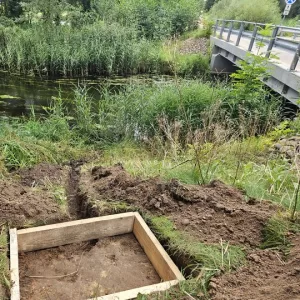
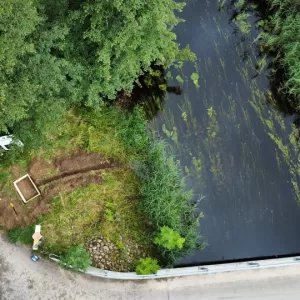
A standard water measurement station consists of a solar power source, water level and temperature sensors extended into the river or canal, a directional antenna, and a metal structure housing a data logger for collecting and transmitting data. “This station will collect data all year round. Our hydrology specialists will visit each site three times a month to ensure and maintain data quality and control. The stations will autonomously measure both mentioned parameters every hour, so we will receive 24 water level and temperature readings per day. The more times measurements are taken, the longer the sequence of numbers and the more accurate the arithmetic mean, indicating both temperature and water level fluctuations,” emphasizes the interviewee. “Hydroelectric plant owners are already required to record water levels every hour, but it happens that data is falsified or not provided at the specified frequency. To produce more electricity, some hydroelectric plant owners do not maintain the required water level in the hydroelectric pond or below the plant. Automatic measurement stations will help avoid inaccurate data. With reliable information, we will be able to respond appropriately and take measures to ensure the survival of water ecosystems.”
Hopes for cooperation from hydroelectric plant owners
- Sližys explains that some hydroelectric plant owners are favorably disposed—they agree to eliminate violations identified during planned and unplanned inspections with inspectors from the Living Nature Division. “In the Bartkuškis hydroelectric plant in the fall of 2024, a low water level was detected. Usually, in such cases, a warning is issued or an administrative offense is recorded, but the hydroelectric plant owner offered to adjust the turbine blades himself: by raising them a few centimeters, the water level was raised, ensuring compliance with the established rules. Of course, this is not possible in all cases, as some hydroelectric plants have old turbines that can only be turned on or off,” notes the expert. “The decision on where to place automatic water measurement stations was not made by chance. Although in the first phase of the project we will cover only 10% of the hydroelectric plants operating in Lithuania, we have chosen the ten most problematic points in various parts of Lithuania. We constantly receive information about them from people who notice a drastic drop in water levels or, in the case of the Vilnelė, a complete absence of water at night. The situation is also complicated in the Virvytė River, where several hydroelectric plants operate. It is gratifying that people are not indifferent and report potential harm to nature.”
The main goal is ecosystem protection
Based on data from automatic water measurement stations, the impact of hydroelectric plant operations on the hydrological regime of rivers and the redistribution of water quantity over time will be investigated. According to these indicators, colleagues from the Lithuanian Energy Institute will develop a methodology to optimize the operation of hydroelectric plants, so that daily water level fluctuations are minimized and the negative impact on water ecosystems is reduced.
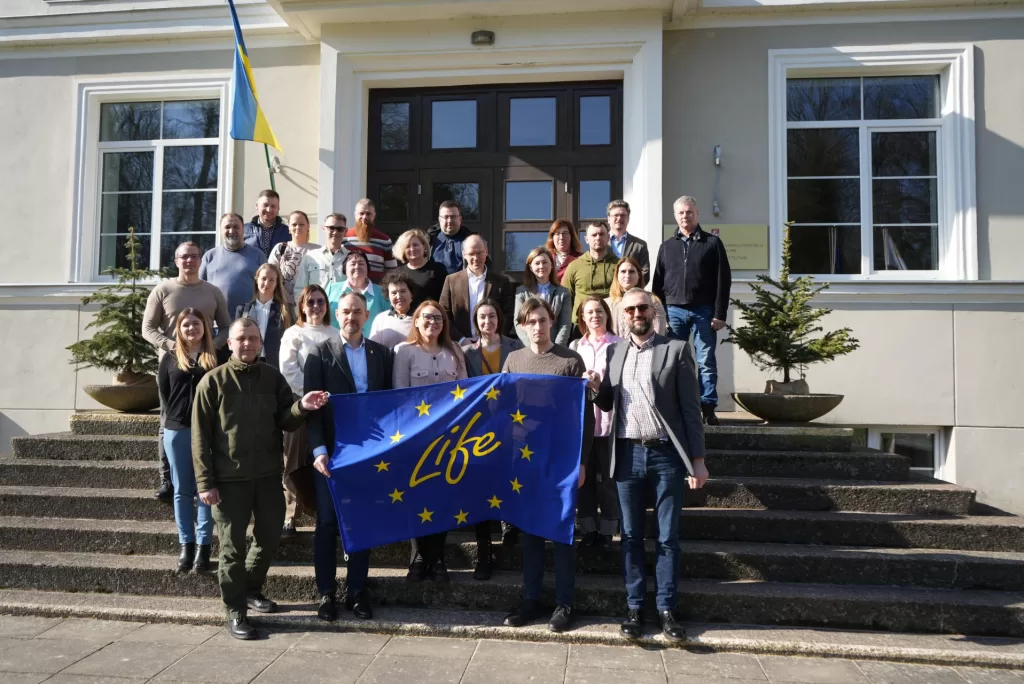
“The smaller the water level change, the less impact on nature. We do not aim to restrict or stop the operation of hydroelectric plants; we are simply looking for an optimal way to maintain balance, to operate them properly without harming river ecosystems. The project involves specialists from the Living Nature Division of the Environmental Protection Department, the Lithuanian Energy Institute, the Nature Research Center, and the Nature Heritage Fund. Each partner of the project (LIFE SIP Water) contributes differently and at different stages of project implementation, but they are all united by a common goal—to use the collected data to preserve river ecosystems,” notes G. Sližys.


Results
we aim to achieve

Reduced negative environmental impacts on the country’s surface waters and improved status of surface water bodies.
A cooperation platform developed by experts from participating institutions, ensuring more effective management of surface water bodies.
Investments mobilised through the project will secure funding beyond the project’s lifetime and expand the scale of its results.
Public outreach and communication activities will increase public engagement and encourage behavioural changes that contribute to improving the status of water bodies.
