

 Back
Back
More than 2,000 artificially bred pike juveniles released into lakes in the Vilnius and Trakai districts
2025.10.02
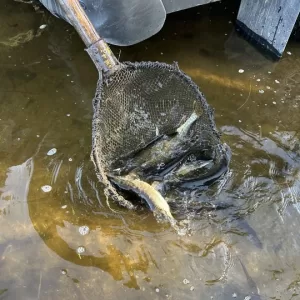
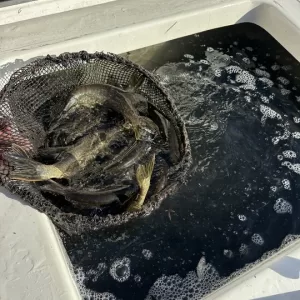
In the first week of October, the Fisheries Service under the Ministry of Agriculture of the Republic of Lithuania released more than 2,000 young pike, each weighing around 300 g, into lakes in the Vilnius and Trakai districts. The fish were artificially bred and reared at the Southern Region Fish Breeding Division of the Fish Breeding Department in Simnas (Alytus district).
It is expected that these predatory fish will help regulate cyprinid fish populations and contribute to improving the ecological status of the selected lakes.
Stocking is carried out on the basis of scientific research, using the biomanipulation method aimed at improving the status of water bodies. These measures are implemented as part of the predatory fish biomanipulation activities under the “LIFE SIP Water” project.
According to Artūras Vaickus, Head of the Southern Region Fish Breeding Division, who delivered the pike to lakes in the Vilnius and Trakai districts, the reared fish—each weighing around 300 g—released into properly prepared water bodies have a high chance of survival.
“All of them are young-of-the-year, originating from spring spawning. Therefore, it is expected that all the reared and released pike will survive—unless one or two are caught by a larger pike or taken by a cormorant,” said A. Vaickus.
Predatory fish are a vital regulator of ecosystems
Predatory fish are the custodians of aquatic ecosystems, maintaining natural balance. They feed on other aquatic organisms—such as fish and amphibians—and in doing so regulate excessive populations of smaller species. If predatory fish were to decline, fry and small fish would begin to dominate, consuming large amounts of zooplankton. As a result, water bodies would lose clarity and become more susceptible to algal blooms.
By helping preserve zooplankton, which naturally purifies water, predatory fish play a direct and vitally important role in maintaining ecological balance.
These fish also “remove” weaker or diseased individuals, helping populations remain healthier. By occupying the top level of the food chain, they stabilise entire ecosystems and prevent any single species from overwhelming others.
Small fish prevent water from becoming clear
According to scientist Dr Tomas Virbickas, biomanipulation using predatory fish is usually applied as the final stage of the restoration process in lakes where significant pollution pressures have already ceased. However, the recovery of aquatic plant and animal communities is often hindered by residual effects caused by past pollution.
For example, a disproportionately high phytoplankton biomass reduces water clarity and prevents the recovery of submerged vegetation, while abundant populations of pelagic and benthic cyprinid fish—unrelated to submerged vegetation—can indirectly promote the proliferation of phytoplankton.
“Lakes with a disturbed ecological balance do not recover naturally. Therefore, even after pollution has been stopped, such water bodies require human intervention. When ecological balance is disrupted, the water becomes turbid—phytoplankton (autotrophic organisms) dominate, and increased turbidity leads to the decline of higher aquatic plants (macrophytes).
It has been scientifically proven that restoring lakes to their original ecological condition requires a significant reduction in phosphorus levels. Another approach is to reduce phytoplankton through biological processes. Since zooplankton feed on phytoplankton, their populations need to be encouraged. Zooplankton are freshwater organisms that passively drift in the water.
“The aim of biomanipulation using predatory fish is to reduce the number of fish that feed on zooplankton. Such species include roach, common bleak, small bream, and others. Introducing predatory fish into lakes helps reduce populations of low-value fish that consume zooplankton. As their numbers decline, zooplankton abundance increases and feeds more intensively on phytoplankton. As a result, water clarity improves and macrophytes begin to grow, which in turn suppress the further development of phytoplankton,” explained scientist Dr Tomas Virbickas.

Dominant cyprinid fish and their impact on lake ecosystems
In the lakes studied by scientists, fish communities consist of 7 to 14 species. Roach and bream—species whose population regulation can help improve ecological status—were found in all 20 lakes studied. White bream occur in 19 lakes, common bleak in 15, Prussian carp in 8 lakes, and common carp were found in one lake.
In terms of both abundance and biomass, roach dominate in nearly all lakes. Only in Lake Simnas is the common bleak the most abundant species, while in Lake Svirkai the white bream dominates by number and the Prussian carp by biomass.
LIFE project: 14,000 young pike released into Lithuanian lakes this year
In the spring of 2025, as part of the LIFE programme project “Integrated Water Management in Lithuania”, artificial pike breeding was successfully carried out at the Southern Region Fish Breeding Division of the Fish Breeding Department of the Fisheries Service in Simnas. Eggs and milt were collected from broodstock and the eggs were fertilised. In total, 300,000 newly hatched larvae were transferred to a closed recirculating aquaculture system (RAS).
From 29 May to 2 June, state-owned water bodies were stocked with reared young-of-the-year pike in order to improve natural fish populations and the ecological status of inland waters. In total, 14.2 thousand artificially bred and reared pike juveniles were released.
The pike juveniles were released into the following water bodies: Lake Simnas (Alytus District) – 1.4 thousand, Lake Alovė (Alytus District) – 1.4 thousand, Lake Savistas (Varėna District) – 0.9 thousand, Lake Kaviškis (Lazdijai District) – 1.4 thousand, Lake Prapuntas (Lazdijai District) – 1.9 thousand, Lake Zapsys (Lazdijai District) – 3.3 thousand, and Lake Švenčius (Kaišiadorys District) – 1.0 thousand individuals.
A 10-year project to improve lake ecology
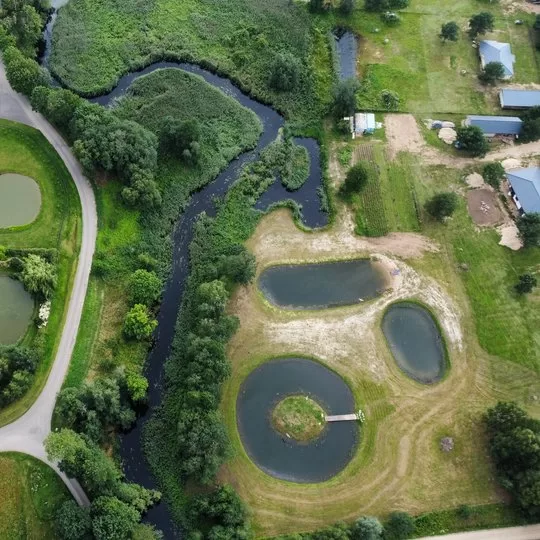
Stocking activities are carried out as part of the LIFE programme project “Integrated Water Management in Lithuania” (Project No. 101104645–LIFE22-IPE-LT–LIFE SIP Water). The Fisheries Service is one of the 15 project partners and is responsible for rearing predatory fish (pike), stocking them in Lithuanian water bodies, and implementing pollution reduction measures in the Dovinė River.
The aim of the project is to improve the ecological status of Lithuanian lakes by applying biomanipulation methods and to address water body status issues in the Dovinė River basin through an integrated approach.
The project coordinator is the Environmental Projects Management Agency under the Ministry of Environment of the Republic of Lithuania. The project will run for 10 years and is implemented under the European Union LIFE Programme, administered by the European Climate, Infrastructure and Environment Executive Agency (CINEA).


Results
we aim to achieve

Reduced negative environmental impacts on the country’s surface waters and improved status of surface water bodies.
A cooperation platform developed by experts from participating institutions, ensuring more effective management of surface water bodies.
Investments mobilised through the project will secure funding beyond the project’s lifetime and expand the scale of its results.
Public outreach and communication activities will increase public engagement and encourage behavioural changes that contribute to improving the status of water bodies.
